

For real estate investors who own rental properties, qualifying for a mortgage based on personal income has always been the main bottleneck. Tax returns that show aggressive deductions, multiple property depreciation, and income spread across several entities rarely tell the story of a cash-flowing real estate portfolio. DSCR loans solve this problem.
A DSCR loan, or debt service coverage ratio loan, qualifies the borrower based on the rental income the property generates rather than the investor’s personal income. If the property produces enough cash flow to cover the mortgage payment, you can qualify. What you earn at your day job is not part of the equation.
This guide covers everything a real estate investor needs to understand about DSCR loans: how the debt service coverage ratio is calculated, what lenders look for, the pros and cons, how to get a DSCR loan, and when this type of loan makes more sense than a conventional loan.
Champions Mortgage (NMLS #1706471) originates DSCR loans for investment properties in Texas, Florida, Georgia, and North Carolina. Call (281) 727-2500 to speak with a loan officer about your specific property.
What Is a DSCR Loan? Quick Answer
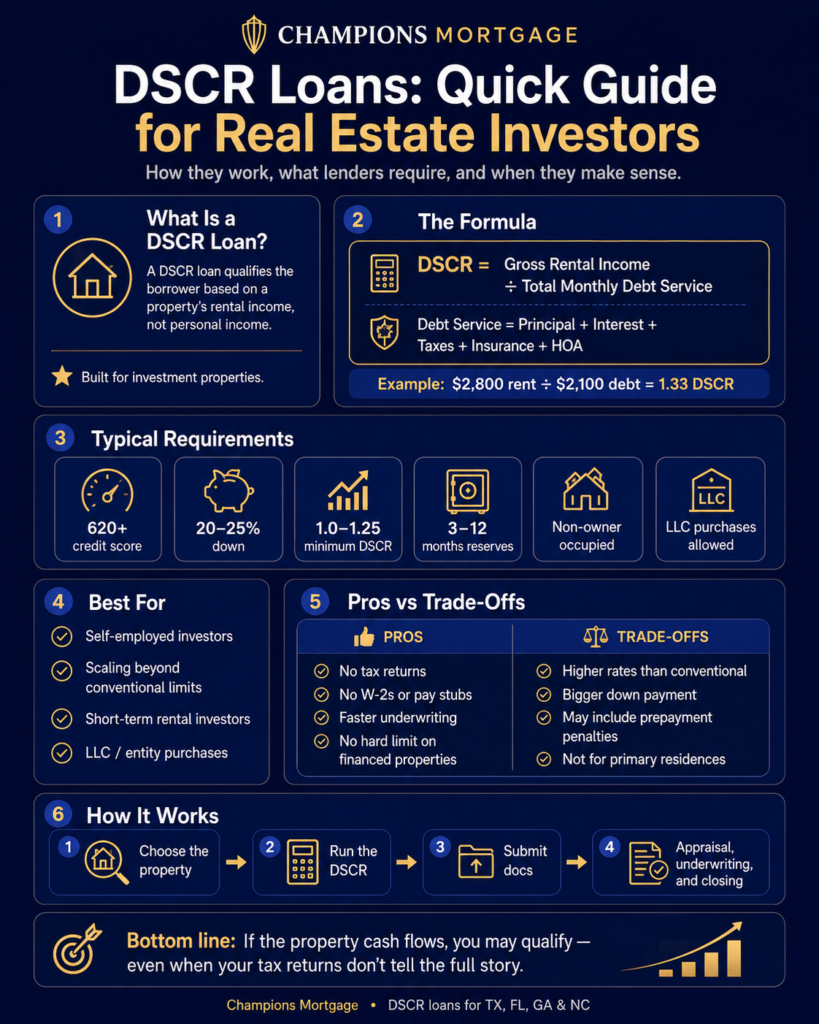
A DSCR loan is a non-QM (non-qualified mortgage) real estate loan that qualifies borrowers based on the cash flow generated by the investment property, not the borrower’s personal income. Lenders calculate the debt service coverage ratio by dividing the property’s gross rental income by its total monthly debt obligations. A DSCR of 1.0 means the property breaks even. Most DSCR loan lenders require a minimum DSCR of 1.0 to 1.25. No personal income documentation, tax returns, or pay stubs are required.
What Is a DSCR Loan and How Does It Differ from a Conventional Loan?
A DSCR loan is a type of real estate loan — specifically a non-QM mortgage — that is designed for real estate investors purchasing or refinancing rental properties. DSCR loans are based on the property’s rental income as the primary qualification metric. The loan allows real estate investors to bypass personal income documentation entirely.
This makes DSCR loans an ideal option for real estate investors who are self-employed, whose tax returns show aggressive deductions, or who have already used their conventional loan eligibility across multiple properties. DSCR financing gives these investors a way to continue growing their real estate portfolio without being constrained by personal income-based underwriting.
Unlike a conventional mortgage loan, which requires the borrower to verify personal income through pay stubs, W-2s, and tax returns, a DSCR loan uses the property’s net operating income and debt obligations to determine loan eligibility. This is what makes DSCR loans ideal for active real estate investors whose portfolios are producing strong cash flow even when their personal income documentation does not reflect it.
DSCR Loan vs. Conventional Loan: Key Differences
| Factor | DSCR Loan | Conventional Loan |
| Income qualification | Property rental income | Borrower personal income |
| Documentation required | Lease agreement or market rent appraisal | Tax returns, W-2s, pay stubs |
| Who it suits | Real estate investors, self-employed buyers | Owner-occupants, W-2 employees |
| Loan type | Non-QM mortgage | QM mortgage (Fannie/Freddie) |
| Credit score minimum | Typically 620-680+ | Typically 620+ (conventional) |
| Down payment | Typically 20-25% | 3-20% depending on loan program |
| DTI ratio required | Not evaluated | Typically 43% max |
| Rate vs. conventional | Slightly higher | Standard market rate |
| Best for | Rental properties, portfolios | Primary residences |
How to Calculate DSCR: The Debt Service Coverage Ratio Formula
The debt service coverage ratio is a straightforward calculation. Understanding it gives you a clear picture of how lenders evaluate your investment property before you apply.
The DSCR Formula
DSCR = Gross Rental Income / Total Monthly Debt Service
Where:
- Gross Rental Income = Monthly rent collected (or market rent per appraisal if the property is vacant)
- Total Monthly Debt Service = Principal + Interest + Taxes + Insurance + HOA dues (PITIA)
DSCR Calculation Example
Say you are purchasing a single-family rental property in Houston, Texas. Here are the numbers:
- Monthly market rent: $2,800
- Proposed mortgage payment (P&I): $1,650
- Property taxes (monthly): $320
- Insurance (monthly): $130
- HOA dues: $0
- Total monthly debt service: $2,100
DSCR = $2,800 / $2,100 = 1.33
A DSCR of 1.33 means the property generates 33% more income than needed to cover its debt obligations. Most DSCR loan lenders would approve this property. A DSCR below 1.0 means the rental income does not cover the mortgage payment, which most lenders will not approve without compensating factors.
What Is a Good DSCR Ratio?
| DSCR Ratio | What It Means | Lender View |
| Below 1.0 | Property cash flow does not cover debt service | Most lenders will not approve. Some offer programs with higher down payment. |
| 1.0 | Property breaks even — income exactly covers debt service | Borderline. Some lenders approve with strong credit score and larger down payment. |
| 1.0 to 1.25 | Property generates modest positive cash flow | Acceptable to most DSCR lenders. Standard approval range. |
| 1.25 to 1.5 | Strong cash flow relative to debt obligations | Good. Better rates and terms typically available. |
| Above 1.5 | Excellent cash flow cushion | Ideal. Maximum flexibility on loan terms, rate, and down payment. |
Most DSCR loan lenders set the minimum DSCR at 1.0, though some programs require 1.10 or 1.25. The higher the ratio, the stronger the approval and the better the mortgage interest rates available to you. When evaluating a potential investment property, run the DSCR calculation before making an offer so you know where the deal stands before applying.
How Does a DSCR Loan Work?
A DSCR loan works like a standard investment property mortgage in its structure — fixed or adjustable rate, amortized over 15 to 30 years — but the loan qualification process is entirely different. Here is how the DSCR loan works from property selection through closing.
DSCR loans can be used across a wide range of loan programs. Some lenders offer interest-only DSCR products for investors who want to maximize early cash flow. Others offer 5/1 or 7/1 ARM structures. Loan products vary significantly between DSCR lenders, so comparing options across multiple lenders matters.
Step 1: Choose the Right Property
DSCR loans are available for a range of investment property types. The rental income from the property must support the mortgage payment. Properties with strong rental demand in your target market produce higher DSCR ratios and easier approvals.
- Single-family rental homes
- 2-4 unit multifamily properties
- Condominiums (non-warrantable condos accepted by many DSCR lenders)
- Short-term rentals (Airbnb, VRBO — some lenders calculate income from platforms)
- Small commercial or mixed-use properties (lender-specific)
Step 2: Run the DSCR Calculation
Use the DSCR formula before you apply. If the property is occupied, use the current lease. If it is vacant, the lender will order a market rent appraisal (Form 1007 Rent Schedule) to establish the income figure used in the DSCR calculation. Run this number against estimated monthly loan payments to confirm the deal meets the lender’s minimum DSCR requirement before submitting your loan application.
Step 3: Meet the Basic Qualification Requirements
DSCR loans do not require personal income documentation, but lenders still evaluate the borrower on credit score, loan-to-value ratio, and reserves. These are the standard DSCR loan requirements across most lenders:
- Credit score: Minimum 620-680 depending on lender and loan amount. Higher credit scores access better rates.
- Down payment: Typically 20-25% of the purchase price. Some programs allow 15% with higher rates.
- Loan-to-value ratio: Most lenders cap at 75-80% LTV on purchases, 70-75% on cash-out refinancing.
- Reserves: Most lenders require 3-12 months of mortgage payments in liquid reserves after closing.
- DSCR minimum: Varies by lender, typically 1.0 to 1.25.
- Property must be non-owner-occupied: DSCR loans are for investment properties, not primary residences.
Step 4: Submit the Application
The DSCR loan application is simpler than a conventional mortgage application. You do not submit tax returns, W-2s, or employment verification. The primary documents required are:
- Purchase contract or property address for refinancing
- Existing lease agreement (if property is occupied)
- Bank statements showing reserves
- Entity documents if purchasing through an LLC or other business entity
- Credit authorization
Step 5: Appraisal and Underwriting
The lender orders a full property appraisal, including the 1007 Rent Schedule if the property is vacant. Underwriting evaluates the DSCR ratio, the property condition, and the borrower’s credit profile. DSCR loans do not go through Fannie Mae or Freddie Mac — they are non-QM products funded by private capital, so underwriting criteria vary more between lenders than on conventional loans.
Step 6: Closing
DSCR loans typically close in 21-30 days on a standard purchase. Unlike conventional loans, there is no income verification waiting period. Many DSCR loan lenders can move faster on clean applications with strong DSCR ratios and ready documentation.
How to Qualify for a DSCR Loan
To qualify for a DSCR loan, the property must generate enough income to meet the DSCR threshold set by your lender. Unlike conventional loan qualification, which evaluates your personal debt-to-income ratio, DSCR loan qualification focuses entirely on the property. Here are the standard DSCR loan requirements across most lenders.
DSCR Loan Requirements
DSCR loan requirements differ from conventional mortgage loan requirements in one fundamental way: there is no personal income test. A DSCR lender evaluates the property’s income and the borrower’s creditworthiness — not employment history, not W-2s, not tax returns.
Lenders typically require a DSCR that demonstrates the property’s income is sufficient to meet its debt obligations. Here are the core requirements:
- DSCR minimum: Most lenders set the minimum DSCR requirement at 1.0 to 1.25. Lenders typically require a DSCR of at least 1.0 for standard approval. A higher DSCR unlocks better loan terms and lower interest rates.
- Credit score: Minimum 620 to 680 depending on lender and loan products offered. Higher credit scores access better mortgage rates.
- Down payment: Typically 20-25% of the purchase price. Some DSCR loan programs allow 15% down with a higher interest rate.
- Loan-to-value ratio: Most DSCR lenders cap at 75-80% LTV on purchases and 70-75% on cash-out refinancing.
- Reserves: Most programs require 3-12 months of monthly loan payments in liquid reserves after closing. This is a key DSCR requirement that varies significantly between lenders.
- Minimum loan amount: Most DSCR lenders set a minimum loan amount of $100,000 to $150,000. Maximum loan amounts vary by lender but typically go up to $3M-$5M for standard programs.
- Property type: Non-owner-occupied investment properties only. DSCR loans are not available for primary residences.
One important distinction: DSCR loans often require the borrower to have real estate investing experience for higher loan amounts. First-time investment property buyers may face stricter DSCR requirements or lower maximum loan limits at some lenders. Ask your loan officer directly about the lender’s experience requirements before applying.
Documents Required to Get a DSCR Loan
The loan application for a DSCR loan is simpler than a conventional mortgage. You submit:
- Purchase contract or property address for refinancing
- Existing lease agreement (if occupied) or market rent appraisal
- Bank statements showing post-closing reserves
- LLC operating agreement and articles of organization (if purchasing through an entity)
- Credit authorization
No tax returns. No W-2s. No pay stubs. No employment verification. This streamlined loan application process is one of the primary reasons real estate investors use DSCR loans over conventional mortgage alternatives.
Who Should Use a DSCR Loan?
DSCR loans are typically used by experienced real estate investors who cannot qualify for conventional financing based on personal income alone. Here are the specific profiles where DSCR loans deliver the clearest advantage in the current real estate market.
Self-Employed Investors
A self-employed real estate investor who takes aggressive deductions, depreciates multiple properties, and runs income through an LLC will often show little taxable personal income on their tax return. Conventional loan underwriting uses that net income figure. A DSCR loan ignores the tax return entirely and focuses only on the property’s cash flow.
Investors Who Have Reached Conventional Loan Limits
Fannie Mae limits the number of financed investment properties a borrower can have to 10. Many active real estate investors hit this ceiling. DSCR loans are not subject to Fannie Mae or Freddie Mac guidelines, so there is no hard limit on the number of DSCR loans a real estate investor can hold. This makes them an important tool for scaling a real estate portfolio beyond what conventional financing allows.
Foreign National Investors
Non-US citizens investing in American rental properties often lack the Social Security numbers and US credit history required for conventional loans. Many DSCR loan lenders offer programs for foreign nationals who own investment properties in the US, qualifying them on the property’s cash flow rather than their personal financial history.
Investors Seeking Fast Closings
Because DSCR loans skip income verification, they can close significantly faster than conventional investment property loans in some cases. For investors competing in tight markets where speed matters, a DSCR loan’s streamlined underwriting is a practical advantage.
DSCR Loans for Short-Term Rentals vs. Long-Term Rentals
One of the more complex aspects of DSCR loan underwriting is how lenders handle short-term rental properties. The income calculation differs significantly from a standard long-term rental.
Long-Term Rental DSCR Calculation
For a property with an existing lease or a standard 12-month rental agreement, lenders use the monthly lease amount to calculate the DSCR ratio. This is straightforward. The lease is the income figure. Lenders verify it against the 1007 Rent Schedule to confirm the rent is at or below market rate.
Short-Term Rental (Airbnb/VRBO) DSCR Calculation
Short-term rental income is more variable. Occupancy rates, seasonal patterns, and platform changes all affect actual revenue. DSCR lenders handle this in one of two ways:
- AirDNA or similar platform data: Some lenders use third-party short-term rental market data to estimate achievable rental income for the property in its specific location.
- 12-month trailing income: If the property is an existing short-term rental with an operating history, lenders may use the actual net rental income from the previous 12 months of platform statements.
- Market rent appraisal only: Some lenders revert to the standard long-term market rent from the 1007 appraisal, which typically produces a lower income figure than actual short-term rental revenue.
If you own or plan to purchase a short-term rental property, confirm how your specific lender calculates income before committing to an application. The approach varies significantly and affects whether the deal qualifies at all.
Using a DSCR Loan Through an LLC
One of the most practically useful features of DSCR loans for active real estate investors is that most DSCR loan lenders allow purchases through a limited liability company (LLC) or other business entity. Conventional loans generally require the borrower to be an individual, not an entity.
Purchasing rental properties in an LLC provides liability protection — if a tenant sues the property owner, the lawsuit is directed at the LLC rather than the individual investor’s personal assets. For investors building a real estate portfolio, this structural protection becomes more important as the portfolio grows.
When purchasing through an LLC, the lender will require the LLC operating agreement, articles of organization, and evidence of the borrower’s ownership interest. The DSCR ratio calculation does not change. The property’s cash flow still determines qualification, regardless of whether the borrower is an individual or an entity.
Note: Some lenders require that the LLC be established before application. Forming the LLC after entering contract can delay closing. If you plan to purchase through an entity, establish it before you make an offer.
DSCR Loan Pros and Cons
Advantages of DSCR Loans
- No personal income required: Qualify based on property cash flow, not W-2s or tax returns.
- No limit on the number of properties: Unlike conventional loans capped at 10 financed properties, real estate investors can scale their real estate portfolio through multiple DSCR loans.
- LLC purchases allowed: Maintain liability protection on investment properties.
- Faster underwriting: No income verification typically means fewer documentation requests and faster approvals.
- Available for short-term rentals: Some lenders accept Airbnb/VRBO income where conventional loans would not.
- Works for self-employed investors: Eliminates the personal income documentation that causes most self-employed investors to fail conventional underwriting.
Disadvantages of DSCR Loans
- Higher interest rates: DSCR loans are non-QM products priced above conventional mortgage rates. Expect mortgage interest rates 0.5-1.5% above comparable conventional investment property loans.
- Larger down payment: Most DSCR loan lenders require 20-25% down versus some conventional programs that allow lower down payments.
- Not for primary residences: DSCR loans are strictly for investment properties. If you want to owner-occupy the property, you need a different loan type.
- Prepayment penalties: Many DSCR loans include prepayment penalties for the first 3-5 years. Confirm the prepayment terms before closing.
- Higher reserve requirements: Lenders typically require more post-closing reserves on DSCR loans than on conventional loans.
- More lender variation: Because DSCR loans are non-QM, underwriting guidelines vary significantly between lenders. A deal that does not work with one lender may work with another.
How to Use a DSCR Loan Calculator
A DSCR loan calculator helps real estate investors evaluate a potential deal before applying. The inputs are:
- Monthly gross rental income (current lease or market rent)
- Estimated mortgage payment (P&I based on purchase price, down payment, and current rates)
- Monthly property taxes
- Monthly insurance premium
- Monthly HOA dues (if applicable)
The calculator outputs the DSCR ratio and tells you whether the property meets the minimum DSCR threshold for the loan program you are targeting. Run this calculation on every potential investment property before making an offer. If the DSCR comes in below 1.0 at the target purchase price, you know exactly how much you need to renegotiate the price or increase the down payment to make the deal work.
Champions Mortgage has a mortgage calculator on our website for estimating monthly payment costs. For a personalized DSCR calculation on a specific investment property, speak directly with one of our loan officers.
Is a DSCR Loan Right for Your Investment Strategy?
DSCR loans are a great option for real estate investing when the deal structure makes sense. They are not always the best choice. Here is a decision framework.
When a DSCR Loan Makes Sense
- You are self-employed or your personal income does not reflect your actual financial position.
- You already own more than 10 financed properties and have hit the conventional loan ceiling.
- You want to purchase inside an LLC for liability protection.
- The investment property has strong rental income that comfortably covers the mortgage payment.
- You need a faster closing than conventional investment property financing can deliver.
- The property is a short-term rental and you have platform data to support the income.
When a Conventional Loan May Be Better
- You qualify on personal income and the investment property has a relatively low DSCR ratio.
- You are purchasing your first investment property and want to minimize interest costs.
- The property will be owner-occupied — DSCR loans are not available for primary residences.
- You want to avoid prepayment penalties and plan to refinance or sell within 3-5 years.
Decision rule of thumb: If your personal income supports the debt load and you are under the 10-property conventional limit, a conventional investment property loan will typically offer better mortgage interest rates. If either of those conditions does not apply, a DSCR loan is worth evaluating seriously.
How to Get a DSCR Loan with Champions Mortgage
Champions Mortgage (NMLS #1706471) originates DSCR loans for real estate investors in Texas, Florida, Georgia, and North Carolina. Here is how to get started.
- Call (281) 727-2500 or submit an inquiry online to connect with a DSCR-experienced loan officer.
- Share the property address and the lease or market rent information.
- Run the DSCR calculation together to confirm whether the deal qualifies.
- Submit the application — no tax returns or W-2s required.
- Receive your Loan Estimate within one business day.
- Close in as little as 21 days on a clean purchase transaction.
- NMLS #1706471 | Licensed in TX, FL, GA, NC
- DSCR loan origination for long-term and short-term rental properties
- LLC purchases accepted
- Competitive rates on non-QM investment property loans
Frequently Asked Questions: DSCR Loans
What does DSCR stand for in mortgage lending?
DSCR stands for Debt Service Coverage Ratio. In mortgage lending, it describes the ratio between a rental property’s gross income and its total monthly mortgage payment (principal, interest, taxes, insurance, and HOA dues). A DSCR of 1.0 means the property breaks even. A DSCR above 1.0 means the property generates more income than its debt obligations require.
What credit score do you need for a DSCR loan?
Most DSCR loan lenders require a minimum credit score of 620 to 680, depending on the lender and the specific loan program. Higher credit scores unlock better mortgage interest rates on DSCR loans. Some lenders offer DSCR programs for credit scores as low as 600 with compensating factors such as a larger down payment or higher DSCR ratio.
Can I use a DSCR loan for a short-term rental?
Yes. Many DSCR loan lenders offer programs for short-term rental properties. Income calculation varies by lender. Some use AirDNA market data. Others use 12 months of actual platform income history. Some revert to the long-term market rent from the appraisal. Confirm which method your lender uses before applying, as it directly affects whether the deal qualifies.
Do DSCR loans require tax returns?
No. DSCR loans are specifically designed to avoid personal income documentation. You do not submit tax returns, W-2s, pay stubs, or employment verification. The property’s rental income, verified through a lease agreement or market rent appraisal, is the primary qualification factor.
How many DSCR loans can I have?
There is no standard limit on the number of DSCR loans a real estate investor can hold, unlike conventional loans which cap at 10 financed properties. Individual lenders may have their own portfolio limits, but the product itself does not have a federally imposed ceiling. This makes DSCR loans a key financing tool for investors building larger real estate portfolios.
What is the minimum DSCR for approval?
Most DSCR loan lenders set the minimum DSCR at 1.0, meaning the property must at least break even on cash flow. Some lenders require a minimum DSCR of 1.10 or 1.25 for standard approval. A few lenders offer programs for properties with a DSCR below 1.0, but these typically require a larger down payment and carry higher interest rates.
What is the down payment for a DSCR loan?
Most DSCR loan programs require a down payment of 20-25% of the purchase price. Some lenders offer programs at 15% down with higher rates or stricter requirements. The loan-to-value ratio on most DSCR purchases is capped at 75-80%, meaning you need at least 20-25% equity at closing.
Can I buy an investment property through an LLC with a DSCR loan?
Yes. This is one of the most commonly used features of DSCR loans. Most DSCR lenders allow purchases through an LLC, corporation, or other business entity. You will need to provide the LLC operating agreement and articles of organization as part of the application. The DSCR calculation and qualification criteria remain the same regardless of whether you purchase as an individual or through a business entity.
Key Takeaways: DSCR Loans for Real Estate Investors
Summary : A DSCR loan (debt service coverage ratio loan) is a non-QM mortgage that qualifies real estate investors based on property cash flow rather than personal income. The DSCR ratio is calculated by dividing gross rental income by total monthly debt service. A DSCR above 1.0 means the property covers its own mortgage. Most lenders require a minimum DSCR of 1.0 to 1.25, a down payment of 20-25%, and a credit score of 620 or higher. DSCR loans allow LLC purchases, have no limit on the number of properties financed, and do not require tax returns or personal income documentation. They carry slightly higher interest rates than conventional investment property loans and often include prepayment penalties.