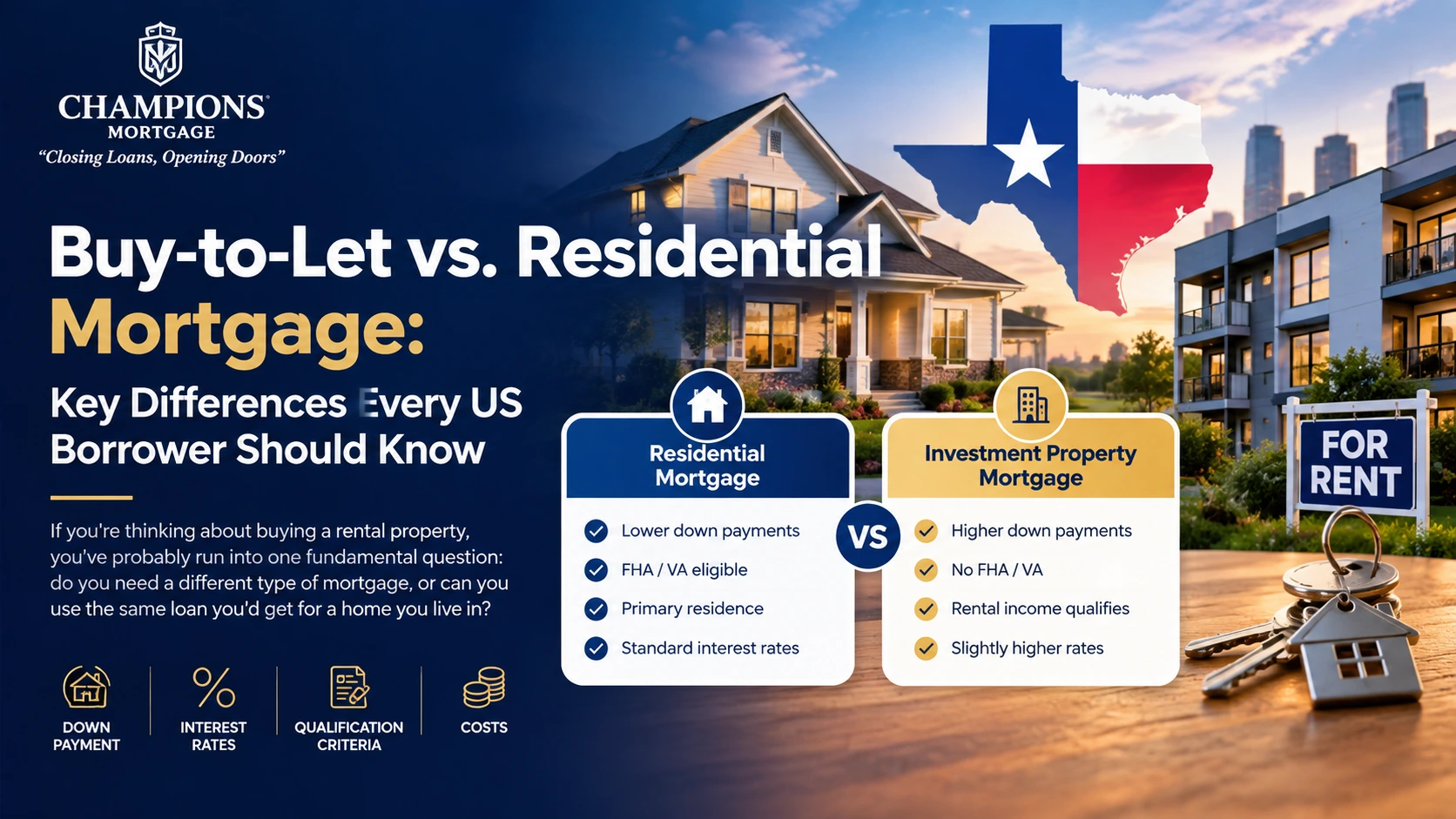

If you’re thinking about buying a rental property, you’ve probably run into one fundamental question: do you need a different type of mortgage, or can you use the same loan you’d get for a home you live in? The short answer is no — a buy-to-let mortgage and a residential mortgage are two different loan types with different rules, different qualification criteria, and different costs.
Understanding the key differences between these two mortgage types before you apply saves time, prevents surprises during underwriting, and helps you choose the right mortgage for what you’re actually trying to do.
This guide breaks down exactly how buy-to-let mortgages and residential mortgages differ — including down payment requirements, interest rates, rental income rules, eligibility criteria, and who each mortgage type is designed for.
Buy-to-Let vs. Residential Mortgage
The key differences US borrowers should understand before choosing financing for a primary residence or an investment property.
| Factor | Residential Mortgage For a home you live in | Buy-to-Let / Investment Property For a property you rent out |
|---|---|---|
| Down Payment | ✓ 3–20% | ✓ 15–25% minimum |
| Interest Rate | Typically based on standard residential pricing | Typically 0.25–0.75% higher than comparable residential financing |
| FHA / VA Eligible | ✓ Yes | ✕ No |
| Rental Income | Not applicable for primary-residence qualification | ✓ 70–75% may be counted toward qualifying income |
| DSCR Loan | ✕ Not available | ✓ Available |
| Reserves Required | Typically 0–2 months | Typically 2–6 months of PITI |
| Occupancy | ✓ Borrower must live in the property | ✓ Property is intended to be rented |
What Is a Residential Mortgage?
A residential mortgage is a home loan for a property you intend to occupy as your primary residence. You live there. That is the defining feature lenders underwrite against.
Residential mortgages in the US come in several types: conventional, FHA, VA, and USDA. Each has different down payment floors, credit score minimums, and income requirements. Because lenders know you will prioritize paying the mortgage on the home you live in, residential loans carry less default risk. That lower risk translates into lower interest rates, smaller required down payments, and more flexible eligibility criteria.
Residential mortgages are governed by federal consumer protection rules under the CFPB (Consumer Financial Protection Bureau) and Regulation Z. They are fully regulated products with standardized disclosure requirements. You receive a loan estimate within three business days of your application and a closing disclosure three days before closing.
What Is a Buy to Let Mortgage?
A buy-to-let mortgage (called an investment property loan or rental property mortgage in standard US lending) is specifically for real estate you plan to rent out rather than live in. The property generates rental income, and lenders assess the loan differently because the risk profile differs from a primary residence.
In the United States, buy-to-let financing falls into two main categories:
- Conventional investment property loans: underwritten to Fannie Mae and Freddie Mac guidelines. Available for 1-4 unit residential rental properties. Your personal income, credit history, and DTI are the primary qualification factors, with rental income used as a supplement.
- DSCR loans (Debt Service Coverage Ratio loans): a non-QM product where the property’s rental income is the primary qualification metric. Your personal tax returns and employment history are not required. The loan is approved based on whether the property generates enough rent to cover the mortgage payment.
The term “buy-to-let mortgage” is widely used in the UK, where it refers to a specific regulated product category. In the US, the product exists under different names, but the underlying concept is the same: you borrow money to buy property you intend to rent to tenants.
Key Differences Between Buy-to-Let and Residential Mortgages
The two mortgage types serve different purposes and come with different qualification rules, costs, occupancy requirements, and financing options. Here’s how they compare side by side.
Residential Mortgage
For a home you live inBuy-to-Let Mortgage
For property rented to tenantsDown Payment: The Biggest Practical Difference
The down payment gap is where most first-time real estate investors get caught off guard. They assume the same low-down-payment options available for primary residences apply to rental properties. They do not.
For a primary residence, you can put down as little as 3.5% with an FHA loan or 3-5% on some conventional products. VA-eligible borrowers can go to zero down.
For a buy-to-let property, the floor is much higher:
- Single-family rental home: 15% minimum (20% to avoid private mortgage insurance)
- 2-4 unit rental property (duplex, triplex, fourplex): 25% minimum under Fannie Mae guidelines
- DSCR loan for any rental property: typically 20-25% depending on the lender
That down payment must come from verifiable, seasoned funds. The money needs to have been in your account for at least 60 days. Gift funds from family members are generally not acceptable for investment property down payments the way they are for primary residences.
The practical effect: to buy a $350,000 rental property in Texas, you need $70,000 to $87,500 for the down payment alone, before closing costs. Plan accordingly.
Interest Rates: Why Buy-to-Let Mortgages Cost More
Buy-to-let mortgage rates are higher than residential mortgage rates for the same borrower, typically 0.25% to 0.75% above the primary residence rate for comparable credit and loan terms. On a $300,000 loan, that difference translates to roughly $50 to $150 more per month in mortgage payment and tens of thousands of dollars over a 30-year term.
The rate premium exists because lenders view investment property loans as higher risk. When borrowers face financial difficulty, they typically stop paying the rental property mortgage before the mortgage on their home. Lenders price for that risk with higher rates.
Factors that affect your buy-to-let mortgage rate:
- Credit score: a 740+ score gets you meaningfully better pricing than 620
- Down payment: more equity at purchase lowers your loan-to-value ratio and your rate
- Loan type: conventional investment property loans and DSCR loans price differently
- Property type: single-family homes generally get better rates than 2-4 unit properties
- Loan term: a 30-year vs. 15-year term affects the rate
- Market conditions: rates move with the broader mortgage market and Federal Reserve policy
One important note: unlike UK buy-to-let products, US investment property loans are almost never interest-only on the conventional side. Standard US investment property loans are fully amortizing, meaning you pay both principal and interest each month. Interest-only structures are available through some DSCR lenders and portfolio lenders, but they are the exception, not the standard product.
How Rental Income Affects Mortgage Qualification
On a residential mortgage, rental income is irrelevant because you are buying the home to live in. On a buy-to-let loan, rental income is central to the qualification math. Here is how lenders use it.
Conventional Investment Property Loans
Lenders typically credit you with 70-75% of the projected monthly rental income and count that toward your qualifying income. The 25-30% reduction accounts for vacancy periods, maintenance costs, and management expenses.
Example: a rental property expected to generate $2,000 per month in rent gives you $1,400 to $1,500 in qualifying income from the lender’s perspective. That amount offsets the new mortgage payment in your debt-to-income calculation.
Rental income must be documented with a signed lease agreement (for existing tenants) or a market rent analysis from a licensed appraiser (for vacant properties).
DSCR Loans
DSCR loans flip the qualification model entirely. Instead of calculating your personal debt-to-income ratio, the lender calculates the property’s Debt Service Coverage Ratio:
| DSCR Formula: Monthly Gross Rental Income divided by Monthly PITI Payment = DSCR Example: Monthly rent: $2,200 Monthly PITI: $1,750 DSCR: 2,200 / 1,750 = 1.26 A DSCR of 1.0 means the property breaks even on cash flow.Most lenders want 1.0x or above. A DSCR of 1.25+ signals healthy cash flow. |
Your W-2s, tax returns, and employment history are not required on a DSCR loan. This makes DSCR the right fit for self-employed investors, foreign nationals, visa holders, and borrowers whose personal income documentation does not reflect their actual financial strength.
Eligibility Criteria: Who Qualifies for Each Mortgage Type
Residential Mortgage Eligibility
Residential mortgage eligibility centers on your personal financial profile: stable employment history (typically 2+ years in the same field), documented income from W-2s or tax returns, a credit score of 580+ for FHA or 620+ for conventional, a DTI ratio below 43-50%, a down payment from 3-20%, and intent to occupy the property as your primary residence.
Government-backed programs like FHA, VA, and USDA expand access for borrowers with lower credit scores, smaller down payments, or limited savings. None of those advantages carry over to buy-to-let financing.
Buy-to-Let Mortgage Eligibility
Investment property loan eligibility adds several layers on top of a standard residential application:
- Credit score of 620 minimum; 680+ for competitive rates
- Down payment of 15-25% from verified, seasoned funds
- Post-closing reserves of 2-6 months PITI
- DTI within conventional limits (43-45%) or the property passes the DSCR test
- Property must be viable as a rental; the appraiser confirms market rent
- Borrower must NOT intend to occupy the property
First-time buyers can apply for buy-to-let loans in the US, but most conventional lenders prefer borrowers who already own a primary residence. DSCR loans are more accessible for first-time real estate investors because the property’s income drives the qualification.
For foreign nationals and all US visa types (including H-1B, L-1, O-1, and others), DSCR loans are available at Champions Mortgage. The loan qualifies on the property’s rental income, so US employment history is not the primary requirement.
Can You Rent Out a Property With a Residential Mortgage?
If you take out a residential mortgage, representing to the lender that you will live in the property, and then rent it out without disclosure, you are violating your mortgage agreement. Lenders call this occupancy fraud, and it carries serious legal consequences under federal law.
Most lenders require you to move in within 60 days of closing and maintain the property as your primary residence for at least 12 months. After that period, contact your lender before renting out the property.
Legitimate scenarios where renting is allowed on a residential mortgage:
- Renting out a room in the home you are living in (as a lodger): most residential loans permit this
- Life changes after the occupancy period: if you relocate after 12 months, most lenders allow rental with prior notification
- Refinancing to an investment property loan to properly reflect the property’s use
Which Mortgage Type Do You Actually Need?
Which Mortgage Type Do You Actually Need?
Your financing needs depend on what you’re doing with the property. Use the guide below to quickly identify the mortgage type that best fits your situation.
Frequently Asked Questions: Buy-to-Let vs. Residential Mortgage
What is the difference between a buy-to-let mortgage and a residential mortgage?
A residential mortgage is for a property you live in as your primary residence. A buy-to-let mortgage (called an investment property loan in the US) is for property you purchase to rent out to tenants. The two products differ significantly in down payment requirements, interest rates, qualification criteria, and which government loan programs are available. FHA, VA, and USDA loans are restricted to primary residences and cannot be used for buy-to-let purchases.
Are buy-to-let mortgages more expensive than residential mortgages?
Yes. Buy-to-let mortgage interest rates run 0.25-0.75% higher than comparable residential mortgage rates, and the required down payment is significantly larger (15-25% vs. 3-20%). Monthly mortgage payments on an investment property loan will be higher than on a residential loan for the same purchase price. The higher cost reflects the increased risk lenders take on when financing a property you will not be living in.
Can I use an FHA loan to buy a rental property?
No. FHA loans are restricted to primary residences. The same applies to VA loans and USDA loans. To purchase a buy-to-let property, you need a conventional investment property loan or a non-QM product like a DSCR loan. There are no low-down-payment government-backed programs for investment property purchases in the US.
Can I rent out my house if I have a residential mortgage?
Not without lender approval during the required occupancy period, which is typically 12 months from closing. Renting out a property immediately after closing on a residential mortgage while misrepresenting your occupancy intent is occupancy fraud. After the occupancy period, contact your lender before renting out the property, or refinance into an investment property loan to properly reflect its use.
How does rental income affect buy-to-let mortgage qualification?
On a conventional investment property loan, lenders count 70-75% of projected or actual rental income toward your qualifying income to offset the new mortgage payment in your DTI calculation. On a DSCR loan, rental income is the primary qualifying factor. The property’s monthly rent must cover the monthly mortgage payment (PITI) at a ratio of 1.0x or higher. Your personal income and tax returns are not required on a DSCR loan.
What credit score do I need for a buy-to-let mortgage?
The minimum for most lenders is 620. To access better interest rates and more loan product options, aim for 680 or above. Borrowers at 740+ typically receive the most favorable pricing on investment property loans. Credit score requirements are similar whether you choose a conventional investment property loan or a DSCR loan, though exact minimums vary by lender.
Can first-time buyers get a buy-to-let mortgage?
Yes, but it is harder to qualify than for an experienced homeowner. Most conventional lenders prefer borrowers who already own a primary residence. DSCR loans are more accessible for first-time real estate investors since the property’s income drives the qualification rather than your personal history. A larger down payment of 20-25% is required regardless of whether you are a first-time buyer.
What is a DSCR loan and how does it relate to buy-to-let mortgages?
A DSCR (Debt Service Coverage Ratio) loan is a type of buy-to-let financing where the property’s rental income qualifies the loan rather than your personal income. No tax returns or W-2s are required. The lender divides the monthly rent by the monthly mortgage payment. If the ratio is 1.0x or higher, the property qualifies. This mortgage type works well for self-employed borrowers, foreign nationals, investors with complex income structures, and anyone who wants to scale a rental portfolio without personal income limits getting in the way.
Not Sure Which Mortgage Type Fits Your Investment Goals?
Champions Mortgage (NMLS #1706471) works with residential homebuyers and real estate investors across Texas, Florida, Georgia, and North Carolina. Whether you are buying a primary home or your first rental property, we offer both conventional investment property loans and DSCR loan products, including financing for all US visa types and foreign nationals.
The right mortgage type depends on your specific financial situation, the property you are buying, and your investment goals. A 10-minute call with a loan officer who handles both residential and investment property financing will give you a clearer picture than any comparison article can.
Call (281) 727-2500, email info@championsmortgageteam.com, or start your application online today.