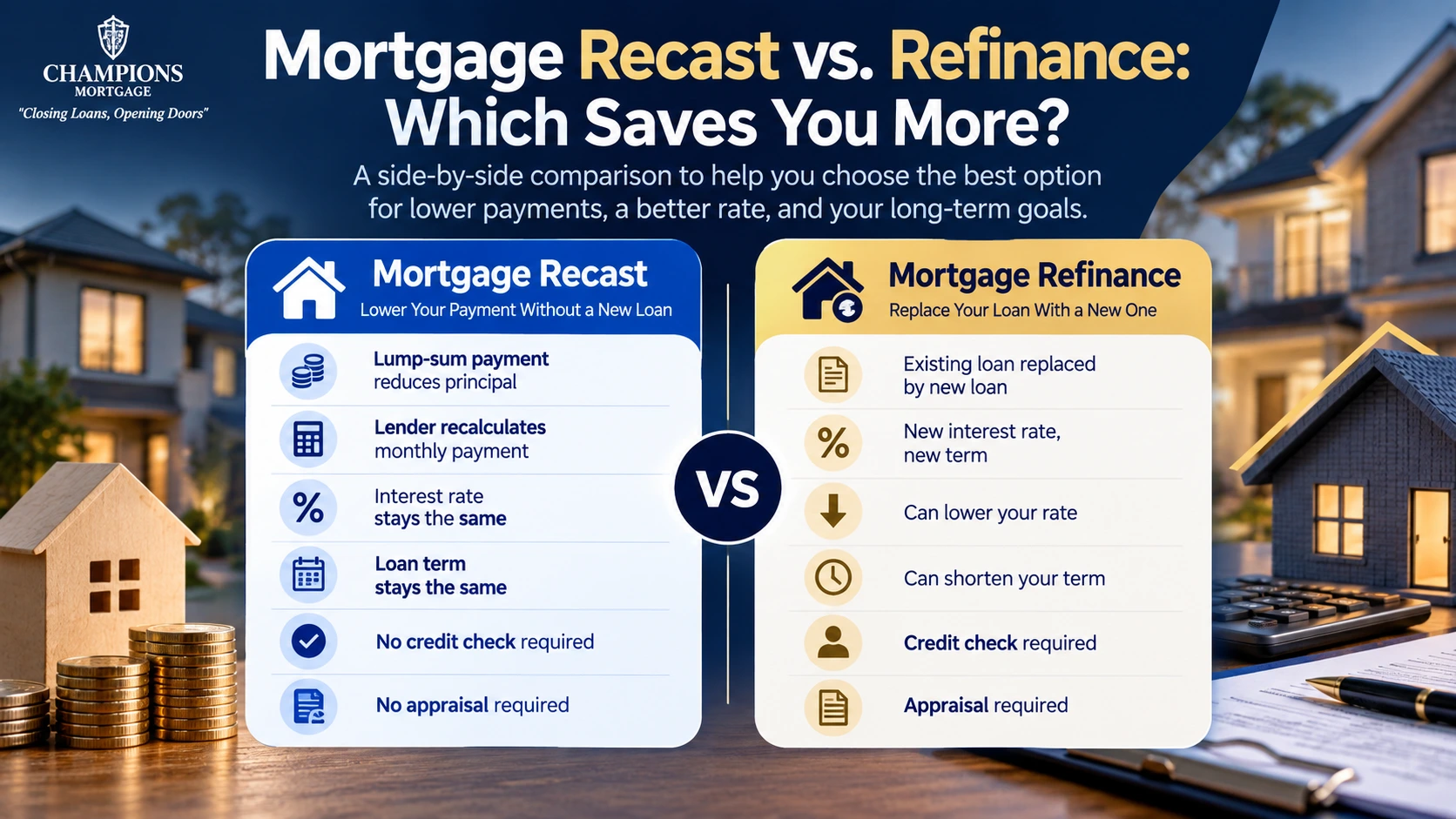

If you have extra cash on hand and want to lower your monthly mortgage payment, you have two main paths: a mortgage recast or a mortgage refinance. Both reduce what you pay each month, but they work in fundamentally different ways and choosing the wrong one can cost you thousands.
This guide breaks down exactly how each option works, what each one costs, when each one makes sense, and how to decide between them given where interest rates stand in 2026.
What Is a Mortgage Recast?
A mortgage recast is when you make a large lump-sum payment toward your mortgage principal, and your lender then recalculates your monthly payment based on the new, lower balance. Your interest rate does not change. Your loan term does not change. The only thing that shifts is your required monthly payment.
Here is a simple example. Say you have 22 years left on a 30-year mortgage at 4.5% and you apply $60,000 toward the principal. Your lender recalculates your monthly payment on the reduced balance spread over the 22 years remaining. Your payment drops — sometimes by several hundred dollars — without you taking on a new loan.
That is the core of mortgage recasting: you are not replacing your mortgage. You are reducing the balance and letting the lender run the math again.
How Mortgage Recasting Works Step by Step
The process is considerably simpler than refinancing. Here is how a typical recast works:
- Contact your lender or servicer. Ask directly whether your loan is eligible for recasting. Not every loan type qualifies.
- Make a qualifying lump-sum payment. Most servicers require a minimum of $5,000 to $10,000, though exact requirements vary by lender.
- Pay the recasting fee. The recasting fee is small — typically between $150 and $500.
- The lender recalculates your monthly payment. Once the lump-sum payment processes, the lender recalculates your monthly payment using the new principal balance over your remaining term.
- Your lower payment begins. Going forward, your statements reflect the reduced monthly obligation.
No appraisal. No credit check. No underwriting. No closing appointment. The process takes roughly two to four weeks from start to finish.
What Is a Mortgage Refinance?
Refinancing replaces your existing mortgage with a brand-new loan. The new loan pays off the old one, and you begin making payments on the replacement, which carries a new interest rate, a new loan term, and a new monthly payment structure.
Unlike recasting, refinancing changes multiple variables at once. Depending on what you want to accomplish, a refinance can:
- Lower your interest rate if current rates are below what you locked in originally
- Shorten your loan term from 30 years to 15 years
- Switch you from an adjustable-rate mortgage to a fixed-rate mortgage
- Give you access to built-up equity through a cash-out refinance
- Remove private mortgage insurance (PMI) if your equity position has grown
Because refinancing replaces the existing mortgage with a new product, you go through a full mortgage application. The lender reviews your credit score, orders a real estate appraisal, verifies your income and employment, and underwrites the new loan before approving it.
How Refinancing Works
The refinance process mirrors getting your original mortgage:
- Apply with a lender. Submit income documentation, employment records, and financial statements.
- Credit check. The lender pulls your credit score to determine eligibility and the rate you qualify for.
- Real estate appraisal. An appraiser establishes the current market value of your home. Not all appraisals work the same way — see the different types of home appraisals and what each one involves.
- Underwriting. The lender reviews all documentation and issues an approval or denial.
- Closing. You sign new loan documents and pay closing costs, which typically run 2% to 5% of the loan amount.
- New loan begins. Your original mortgage is paid off. Payments start on the new loan.
The process usually takes 30 to 60 days.
Mortgage Recast vs. Refinance: Side-by-Side Comparison
Mortgage Recast vs. Refinance
Compare how mortgage recasting and refinancing affect your interest rate, loan term, monthly payment, upfront costs, and qualification requirements.
| Factor |
↻
Mortgage Recast
|
↗
Mortgage Refinance
|
|---|---|---|
| Interest rate | = Unchanged | ↓ Can be reduced |
| Loan term | = Unchanged | ↔ Can be changed |
| Monthly payment | ↓ Reduced | ↓ Can be reduced |
| Credit check required | ✓ No | ✓ Yes |
| Appraisal required | ✓ No | ✓ Yes |
| Upfront cost | $ Recasting fee ($150–$500) | $ Closing costs (2%–5% of loan) |
| Lump-sum payment required | ✓ Yes | — No (except cash-out) |
| Underwriting required | ✓ No | ✓ Yes |
| Eligible loan types | ◆ Conventional, most jumbo | ◆ FHA, VA, USDA, conventional |
| Time to complete | ◷ 2–4 weeks | ◷ 30–60 days |
Important: Actual eligibility, fees, timelines, appraisal requirements, and loan options can vary by lender and individual loan circumstances.
Pros and Cons of Mortgage Recasting
Pros:
- Low upfront cost. The recasting fee is a fraction of what refinancing costs. On a $400,000 loan, refinancing at 3% closing costs means $12,000 out of pocket before you save a dollar. A recast costs a few hundred.
- No credit score impact. Because there is no credit inquiry or underwriting, your credit score is not affected by a recast.
- You keep your current interest rate. If your rate is already below what the market is offering, recasting lets you reduce your monthly payment without trading away that rate.
- Fast and simple. No appraisal, no income verification, no closing. Make the lump-sum payment, wait for the recalculation, and your new payment begins.
- Interest savings over time. Reducing the principal balance means paying less interest over the life of the loan, even though the rate has not changed.
Cons:
- Requires a significant lump sum. Recasting requires deploying a large amount of cash at once. If that money would generate better returns invested elsewhere, tying it up in your home equity may not be the best financial decision.
- Does not lower your interest rate. If current mortgage rates are lower than your existing rate, recasting misses the chance to capture that savings.
- Does not shorten your loan term. If paying off your mortgage faster is the goal, refinancing to a shorter term does what a recast cannot.
- Not all loan types are eligible for recasting. FHA, VA, and USDA loans are generally not eligible. This is a hard limit, not a lender preference.
- Not all servicers offer it. Even on conventional loans, recasting is a lender-level decision. You need to confirm directly with your servicer.
Pros and Cons of Mortgage Refinancing
Pros:
- Can significantly lower your interest rate. Even a 0.75% reduction on a $400,000 mortgage can save hundreds per month and tens of thousands over a 30-year term.
- Can shorten your loan term. Refinancing from 30 years to 15 years at a lower rate dramatically cuts total interest paid, even if the monthly payment increases.
- No lump sum required. Refinancing does not require cash reserves the way recasting does, beyond closing costs (which can sometimes be rolled into the new loan).
- Available on most loan types. FHA, VA, and USDA borrowers can refinance, while those same loan types are not eligible for recasting.
- Access to home equity. A cash-out refinance converts built-up equity into liquid funds for renovations, debt payoff, or other financial needs.
- Can remove PMI. If your home has appreciated and you now have 20% equity, refinancing to a conventional loan can eliminate private mortgage insurance.
Cons:
- Closing costs are substantial. Paying 2% to 5% upfront takes time to recoup through monthly savings. If you sell before the break-even point, the refinance costs more than it saves.
- Resets the loan clock. Starting a new 30-year mortgage means more total interest paid over time, even at a lower rate, if you were already several years into your original term.
- Requires good credit. Lenders require a qualifying credit score for favorable rates. A weakened credit profile can result in a rate that makes refinancing a poor value.
- Takes longer. Refinancing takes 30 to 60 days and involves document collection, an appraisal, and full underwriting.
- Real estate appraisal can complicate things. If your home has dropped in value, a low appraisal can limit your options or derail the refinance entirely.
When Recasting Makes More Sense
Recasting is the better option in several specific situations:
You have a low rate you want to protect. Homeowners who locked in mortgage rates in 2020 and 2021 — when 30-year fixed rates were near historic lows — face a real cost if they refinance today. Refinancing would mean replacing that low rate with a higher one. Recasting lets you lower your monthly payment without giving that rate up.
You just came into a lump sum. An inheritance, a business exit, proceeds from a real estate sale, or a stock vesting event can create the capital needed to recast. If that cash does not have a higher-return destination, using it to reduce your mortgage balance and monthly payment is a straightforward financial move.
You want payment relief without the cost of refinancing. When reducing your required monthly payment is the only goal — and you are not trying to lower your rate or change your term — recasting accomplishes that at a fraction of the cost.
You recently sold a home and applied the equity toward a new purchase. Many buyers use proceeds from a home sale as part of a new purchase, then recast the new mortgage once the dust settles to bring the monthly payment in line with their budget.
Your credit profile is not where you need it for a favorable rate. Recasting bypasses the credit review entirely. If your credit score has declined since you first obtained your mortgage, this may be the only way to reduce your payment without locking in a higher interest rate.
When Refinancing Is the Better Move
Refinancing is the stronger choice when:
Current interest rates are lower than your existing rate. This is the primary driver of most refinancing decisions. A lower rate means a lower monthly payment and less interest paid over time. The math depends on your loan balance, rate differential, and how long you plan to stay in the home.
You want to pay off your mortgage faster. Refinancing from a 30-year to a 15-year mortgage at a lower interest rate can cut total interest costs dramatically. Monthly payments may be higher, but the total cost of ownership drops significantly.
You do not have cash available for a large lump-sum payment. Unlike recasting, refinancing does not require you to have tens of thousands of dollars on hand. Closing costs can sometimes be rolled into the new loan.
You want to remove PMI. If your home value has increased and your equity now exceeds 20%, refinancing to a conventional loan can eliminate private mortgage insurance and reduce your effective monthly cost.
You need to access equity. A cash-out refinance lets you convert built-up equity into cash for home improvements, debt consolidation, or other financial goals. Recasting does not offer this.
You have a government-backed loan and need a lower payment. FHA loans and VA loans are not eligible for recasting. If you have one of these loan types and need a lower monthly payment, a rate-and-term refinance is the mechanism to pursue.
Mortgage Recast vs. Extra Payments: What’s the Difference?
This comparison comes up often. Making extra principal payments reduces your balance, just as a recast does. The key difference is what happens to your required monthly payment.
When you make extra payments without recasting, your required payment does not change. The extra payments accelerate payoff and reduce total interest, but you still owe the same amount each month on your statement. Keep in mind there can also be prepayment considerations, read more about early mortgage payoff penalties before making large unscheduled payments.
When you make a lump-sum payment and recast, the lender recalculates your monthly payment based on the new balance. Your required monthly payment drops immediately.
The right choice depends on your goal. If you want to eliminate the mortgage faster and the monthly payment is already manageable, extra payments do the job. If you need the cash-flow relief of a lower required payment — for a tighter budget, a career change, or added financial cushion — recasting is the right tool.
Which Loan Types Are Eligible for Recasting?
This is one of the most critical factors to confirm before building your strategy around a recast.
Generally eligible for recasting:
- Conventional loans (Fannie Mae and Freddie Mac)
- Jumbo loans (on a lender-by-lender basis)
Generally not eligible for recasting:
- FHA loans (Federal Housing Administration)
- VA loans
- USDA loans
If your mortgage is backed by a government program, recasting is typically not available. The servicer may allow extra principal payments, but the required monthly payment will not be recalculated. In these cases, a refinance is the only mechanism to lower your monthly payment.
Even among conventional loans, not every servicer offers recasting. Contact your loan servicer directly, confirm eligibility, and ask what the minimum lump-sum payment requirement is before making any decisions.
How Much Does a Mortgage Recast Cost?
The recasting fee is the main cost. Most lenders charge between $150 and $500 as a flat processing fee. A small number charge a percentage of the payment, but flat fees are more common.
Compare that to refinancing. At 3% closing costs on a $400,000 loan, you are spending $12,000 before you see a dollar of savings. If refinancing drops your monthly payment by $200, your break-even point is 60 months — five years. If you sell before that, the refinance was a net loss.
A recast at $300 with monthly savings of $150 pays for itself in two months. The cost argument for recasting, when the goal is simply a lower payment, is hard to beat.
Mortgage Recast vs. Refinance: 2026 Interest Rate Considerations
Interest rate context matters when choosing between these two options.
Homeowners who purchased or refinanced in 2020 and 2021, when 30-year fixed mortgage rates were near historic lows, are in a specific position. Refinancing today would mean trading that low rate for a significantly higher one. For most of these borrowers, refinancing to lower a payment does not make mathematical sense. Recasting, for those who are eligible and have cash available, has become the preferred alternative.
Homeowners who purchased between 2022 and 2024 locked in higher rates. For those borrowers, a meaningful drop in interest rates would make refinancing attractive. The key calculation is the break-even point: total closing costs divided by monthly savings tells you how many months it takes to recoup the cost. Refinancing makes sense if you plan to stay in the home well past that point.
Those watching rates in 2026 should keep a close eye on the spread between their current rate and what a refinance would offer, weigh it against closing costs and remaining time in the home, and run both scenarios before committing.
Recast or Refinance: Which Is Better?
Neither option is universally better. The right choice depends entirely on your current rate, your cash position, your loan type, and what you are trying to accomplish.
Here is how to think through it clearly:
Choose a mortgage recast if:
- Your current interest rate is lower than what you could get on a new loan today. Giving up a low rate to refinance costs more in the long run than it saves in monthly payments.
- You have a meaningful lump sum available and no higher-return use for it.
- Your only goal is a lower required monthly payment, not a rate reduction or term change.
- You want to avoid closing costs, a credit inquiry, and the time involved in a full application.
- Your credit profile has weakened since you first obtained your mortgage.
Choose a mortgage refinance if:
- Current interest rates are at least 0.5% to 1% below your existing rate and you plan to stay in the home long enough to recoup closing costs.
- You want to shorten your loan term and pay off the mortgage faster.
- You have an FHA, VA, or USDA loan, which are not eligible for recasting.
- You do not have a large lump sum to put toward the principal.
- You want to access home equity or eliminate private mortgage insurance.
The honest answer for most borrowers in 2026:
If you locked in a rate below 4% between 2020 and 2022, refinancing will almost certainly cost you more than it saves at current market rates. For those borrowers, recasting is the more rational path to payment relief if they have the cash.
If you purchased in 2022 or later at a higher rate, watch the refinance break-even closely. When rates drop far enough that monthly savings recover closing costs in under four years, refinancing becomes the better move.
If your goal is strictly to lower your monthly payment and the two options would produce similar payment results, the recast wins on cost almost every time. The recasting fee is a fraction of refinancing closing costs, the process takes weeks instead of months, and your credit score stays untouched.
When in doubt, run both scenarios with actual numbers. Compare the total cost of each option against the monthly savings each one delivers, and calculate how long you plan to stay in the home. That math tells you which option actually saves more money in your specific situation.
FAQs: Mortgage Recast vs. Refinance
Does a mortgage recast affect your credit score?
No. Recasting involves no credit inquiry, no underwriting, and no new loan. It has no impact on your credit score.
Is there a minimum payment required to recast a mortgage?
Most conventional loan servicers require a lump-sum payment of at least $5,000 to $10,000 to process a recast. Some jumbo loan servicers set higher minimums. Confirm the exact requirement with your servicer before planning your timeline.
Can you recast an FHA loan?
No. FHA loans are not eligible for recasting. The same is true for VA and USDA loans. If you have a government-backed mortgage, refinancing is the mechanism to reduce your required monthly payment.
How long does a mortgage recast take?
Most recasts complete within two to four weeks after the lump-sum payment is processed and applied.
Can you recast and refinance at the same time?
No. These are separate transactions. You would recast your existing loan by applying a large principal payment, or you would refinance by replacing the existing loan with a new one. You would not do both simultaneously, though you could recast now and refinance later if market conditions change.
Does recasting reset or extend your loan term?
No. Recasting does not change your loan term in any way. The remaining term is fixed. Only the monthly payment changes based on the reduced balance.
What is a recasting fee?
The recasting fee is the charge your servicer applies to process the recast. It covers the administrative cost of recalculating your payment and updating your account. Most lenders charge between $150 and $500.
When does it make more sense to recast rather than refinance?
Recasting makes more sense when your current interest rate is already below what you could get on a new loan, when you have cash available to apply as a lump sum, and when your goal is simply a lower required monthly payment rather than a rate reduction or term change.
Talk to Champions Mortgage About Your Options
Both mortgage recasting and refinancing can reduce your monthly payment. The right choice depends on your interest rate, the cash you have available, your loan type, and what you are trying to accomplish long term.
Champions Mortgage works with homeowners across Texas, Florida, Georgia, and North Carolina to figure out which path actually saves more money given the full picture. We can model both scenarios for your specific loan, run the break-even calculation, and show you the total cost comparison before you make a move.
Reach out to the Champions Mortgage team to get started.