

A bank statement mortgage is a type of loan that lets self-employed borrowers qualify using bank statements instead of tax returns.
If you own a business, freelance, or work as an independent contractor, your tax return may show far less income than you actually deposit each month. Legal deductions reduce your taxable income — which is smart tax strategy — but it creates a problem when you apply for a mortgage. Traditional mortgage loans require W-2s and tax returns to verify income. If those numbers look low on paper, the loan gets denied even if your cash flow is strong.
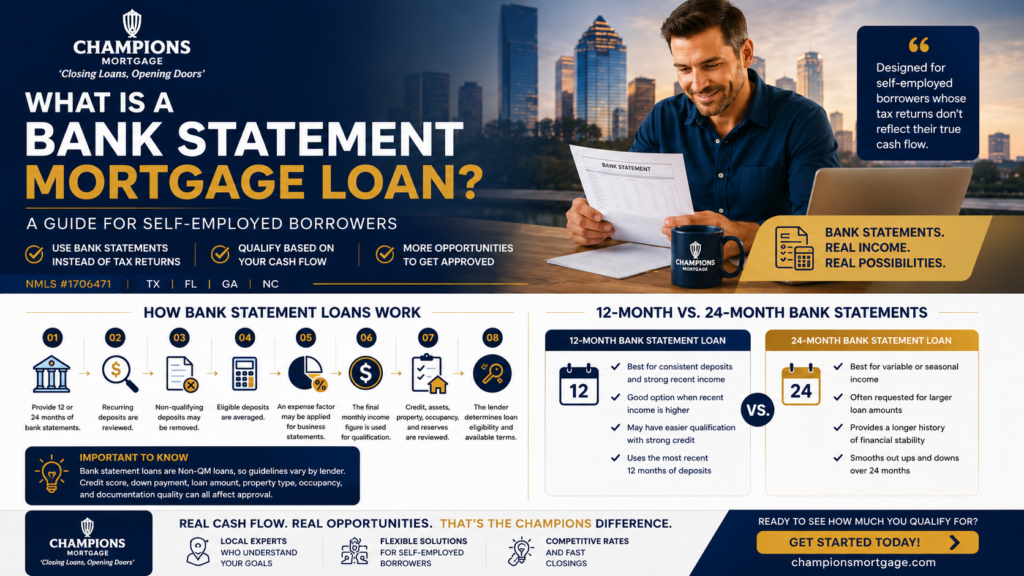
The bank statement mortgage loan exists to solve that problem. Instead of reviewing your tax returns, the lender reviews 12 or 24 months of personal or business bank statements. They calculate your average monthly deposits and use that figure as your qualifying income.
This guide covers what a bank statement mortgage is, how it works, who qualifies, what requirements apply, and how it compares to conventional and government-backed loans. If you are self-employed and have been told you don’t qualify for a standard mortgage, this may be the loan program you need.
QUICK ANSWER: What Is a Bank Statement Mortgage Loan?
| What it is | A non-QM mortgage that uses 12-24 months of personal or business bank statements to verify income instead of tax returns or W-2s. |
| Who it is for | Self-employed borrowers, independent contractors, freelancers, and business owners with 2+ years of self-employment whose tax returns understate actual cash flow. |
| When to use it | When business deductions reduce your taxable income below conventional qualifying thresholds and you cannot qualify using standard income documentation. |
| When NOT to use | When your tax return income already qualifies you for a conventional loan. Conventional rates are lower than bank statement loan rates. |
| Key numbers | 12-24 months of bank statements | 620+ credit score | 10-20% down | Expense factor 25-50% on business accounts | 2+ years self-employment |
What Is a Bank Statement Mortgage Loan?
A bank statement mortgage loan is a non-QM (non-qualified mortgage) loan that uses bank statements to verify income instead of the standard documentation required by conventional or government-backed loans.
“Non-QM” means the loan falls outside the ability-to-repay rules set by the Consumer Financial Protection Bureau for qualified mortgages. Non QM lenders can set their own underwriting standards. That flexibility is what makes it possible to qualify for a mortgage using bank statements instead of tax returns.
Conventional and FHA loans require the lender to verify income through tax returns, W-2s, and pay stubs. For salaried employees, this process is straightforward. For self-employed borrowers, it breaks down. A business owner with significant deductions may show $40,000 of net taxable income while depositing $180,000 per year into their business checking account. A conventional mortgage lender uses the $40,000 figure. A bank statement lender uses the deposits.
A Bank Statement Loan Is Not the Same as a DSCR Loan
Both are non-QM loan products, but they serve different purposes. A bank statement mortgage loan qualifies borrowers based on personal income shown in bank statements. A DSCR loan — Debt Service Coverage Ratio — qualifies investment properties based on rental income. If you’re purchasing a primary residence or second home, a bank statement loan applies. If you’re buying a rental property, a DSCR loan may be more appropriate.
How Does a Bank Statement Mortgage Work?
The bank statement mortgage loan program replaces traditional income documentation with a review of deposit history. Here is the mechanics of how lenders calculate qualifying income from bank statements.
Personal Bank Statements
When a lender reviews personal bank statements, they add up all deposits across the review period — typically 12 or 24 months — and calculate an average monthly figure. That average becomes the qualifying income used to calculate debt-to-income ratio.
One important distinction: the lender looks at deposits, not withdrawals. What you spend does not reduce your qualifying income. What you deposit is the number that matters. Large one-time deposits (asset transfers, insurance proceeds, sale of property) are typically excluded because they don’t represent regular income.
Business Bank Statements
Business bank statements are handled differently. When a borrower uses business bank statements instead of personal ones, lenders apply an expense factor to account for business operating costs. This is because gross business deposits are not the same as personal income — some of those deposits go back out to pay employees, suppliers, and overhead.
The expense factor typically runs between 25% and 50% of gross deposits. If a lender applies a 50% expense factor and your business deposits average $30,000 per month, your qualifying income is $15,000 per month. Different lenders set different expense factors. A lender who applies a 40% expense factor will qualify you for a larger loan amount than one who applies 60%. This is one concrete reason to compare mortgage lenders before you apply.
12 Months vs. 24 Months of Bank Statements
Most bank statement loan programs accept either 12 or 24 months of bank statements. A 12-month review period gives you more recent income history. A 24-month review period smooths out seasonal fluctuations and may produce a more favorable average if income has been growing steadily.
If your business had a down year 18 months ago but income has recovered, 12 months of bank statements may work better for you. If income has been consistent or growing over two years, 24 months gives the lender a stronger picture of stability.
Bank Statement Loan Requirements: What You Need to Qualify
Bank statement loan requirements vary between lenders, but the general framework is consistent. Here is what most bank statement loan programs require.
| Requirement | Typical Standard | Notes |
| Bank statements | 12 or 24 months | 12 months accepted by most lenders; 24 months gives more underwriting clarity |
| Credit score | 620 minimum | Higher score unlocks better rates; some lenders set 640–660 as floor |
| Down payment | 10–20% | 10% possible with 720+ credit; 20% standard for most borrowers |
| LTV | Up to 90% | 80–85% more common; higher LTV requires stronger credit and reserves |
| Reserves | 3–6 months PITI | Some lenders require up to 12 months for larger loan amounts |
| Business ownership | 2+ years self-employed | Verified via business license, CPA letter, or other documentation |
| Income calculation | 12-month deposit average | Business statements: lender applies expense factor (typically 50–75%) |
| Loan amount | Up to $3M–$5M+ | Varies by lender and program; jumbo bank statement loans available |
Self-Employment Documentation
Beyond the bank statements themselves, lenders need to verify that you are genuinely self-employed and that the income is legitimate. This typically means:
- A CPA letter confirming you are self-employed and have been for at least two years
- A business license or other legal proof of business existence
- Proof that the business has been operating for at least 24 months
- A business website, professional profile, or other evidence of an active enterprise
Some lenders require a profit and loss statement from a CPA as a supplemental document. Not all do — but having one ready strengthens the file.
Credit Score and Credit History
Most bank statement loan programs set a minimum credit score of 620. Some lenders require 640 or 660 as their internal overlay. Your credit score determines more than just approval — it directly affects the interest rate you receive on the bank statement mortgage.
Borrowers with 720+ scores typically access the best pricing available on bank statement loans. Borrowers in the 620–680 range qualify for the program but pay a higher interest rate. If your credit score is near a tier threshold, improving it before applying can produce a measurably lower rate.
Pull your credit report before approaching any lender. Address any inaccuracies, pay down revolving balances, and avoid new credit inquiries in the 60–90 days before you apply.
How to Get a Bank Statement Loan: Step-by-Step
Step 1: Pull 12–24 Months of Bank Statements
Start by gathering your bank statements. Personal or business — decide which will produce a stronger qualifying income. Run a rough calculation: add up all deposits over the past 12 months, divide by 12 to get the monthly average. For business accounts, apply a conservative expense factor (say 50%) to estimate what a lender will use. Compare that income figure against the mortgage payment you’re targeting.
Step 2: Check Your Credit Score
Know your score before any lender pulls it. Target 680 or above for the most competitive bank statement loan rates. If your score is below 660, spend time improving it before applying. Even a 20-point improvement can shift your rate tier significantly on a non-QM loan.
Step 3: Confirm Two Years of Self-Employment
Lenders need to see stable, established self-employment. If you have been self-employed for less than two years, most bank statement loan programs will not qualify you. This is not a rigid universal rule — some lenders will consider 12 months of self-employment history if you were previously in the same field as a W-2 employee — but two years is the standard.
Step 4: Find a Mortgage Lender or Mortgage Broker Who Offers Bank Statement Loans
Not every mortgage lender offers bank statement loans. These are non-QM products, and many banks and credit unions stick to conventional and government-backed programs. You need a lender who actively originates non-QM loans.
A mortgage broker with access to multiple bank statement lenders can compare programs on your behalf, which is particularly valuable because expense factors, credit score floors, and rate structures vary significantly between lenders. Reaching out to one bank statement lender gives you one data point. A mortgage broker gives you several.
Step 5: Get a Bank Statement Mortgage Pre-Approval
Mortgage preapproval for a bank statement loan works similarly to conventional preapproval. The lender reviews your bank statements, credit report, employment history, and reserves, then issues a conditional approval for a specific loan amount. Pre-approval is not a final commitment — it is a verified estimate of what you qualify for.
Start the pre-approval process before you identify a property. Sellers in competitive markets take pre-approved buyers more seriously, and knowing your loan amount upfront keeps your property search focused.
Step 6: Submit the Full Application and Close
Once you have a property under contract, submit the full mortgage loan application with your complete bank statement package, business documentation, and reserve verification. The bank statement mortgage underwriting process takes slightly longer than a conventional loan because income calculation requires more manual review. Plan for 30–45 days from application to closing.
Get a Bank Statement Mortgage: Personal vs. Business Bank Statements
This is a decision that affects your qualifying income directly. Here is how to think about it.
Use Personal Bank Statements When:
- Your personal account receives most of the business revenue directly
- Your business has high expenses that would significantly reduce qualifying income under a business expense factor
- You are a sole proprietor and the personal and business finances are closely intertwined
Use Business Bank Statements When:
- Your business revenue is deposited into a dedicated business checking account
- Your personal deposits are lower than your business deposits because you pay yourself a modest salary
- Your business has relatively low operating overhead, which makes the expense factor less punishing
Some borrowers run both scenarios with their lender. Calculate the qualifying income both ways and use the method that produces the higher figure. A loan officer experienced with bank statement loans will do this calculation with you before you commit to an approach.
Key Point: The expense factor applied to business bank statements is negotiable in the sense that different lenders use different factors. If you are a low-overhead consultant or freelancer, seek out lenders who apply a lower expense factor — 25% or 35% instead of 50%.
Self-Employed Borrowers and the Bank Statement Mortgage
The bank statement mortgage loan is specifically built for self-employed borrowers. Understanding why requires understanding the problem it solves.
Why Tax Returns Fail Self-Employed Workers
Self-employed individuals and independent contractors legally reduce taxable income through business deductions. Home office expenses, equipment, vehicle mileage, retirement contributions, business travel, marketing costs — these deductions are legitimate and often substantial.
The result: a business owner who deposits $250,000 per year may show $80,000 in net taxable income after deductions. A conventional loan lender uses the $80,000 figure. At that income level, the qualifying loan amount is limited — often not enough to purchase a home in a major Texas, Florida, Georgia, or North Carolina market.
The bank statement mortgage loan solves this by using actual deposit history. The $250,000 deposited becomes the basis for income calculation. The deductions that helped you at tax time no longer penalize you when you apply for a mortgage.
Who Benefits Most From a Bank Statement Loan
- Small business owners with significant annual deductions
- Freelancers and self-employed workers in creative, technology, consulting, or professional services fields
- Independent contractors in real estate, transportation, healthcare, or skilled trades
- Entrepreneurs who reinvest most profits into the business, reducing personal taxable income
- Real estate investors who also have self-employment income and want to purchase a primary residence
If any of those descriptions apply to you and you’ve been told you don’t qualify for a conventional mortgage, the bank statement loan could be the path forward.
Non-QM Loan vs. Conventional Loan: How Bank Statement Mortgage Loans Compare
The bank statement mortgage loan is a non-QM loan product. Knowing what that means — and how it compares to conventional or government-backed loan programs — helps you make an informed decision.
| Factor | Bank Statement Loan | Conventional Loan | FHA Loan |
| Income verification | Bank statements (12–24 months) | W-2s and tax returns | W-2s and tax returns |
| Best for | Self-employed borrowers | W-2 employees | First-time buyers, lower credit |
| Min. credit score | 620 (varies by lender) | 620 | 580 (3.5% down) |
| Down payment | 10–20% | 3–20% | 3.5% minimum |
| Loan type | Non-QM loan | Conventional / QM | Government-backed / QM |
| Interest rate | Higher (non-QM premium) | Standard market rates | Similar to conventional |
| Mortgage insurance | Not always required | Required below 20% down | Required (MIP) |
The main trade-off is the interest rate. Bank statement loans carry a higher interest rate than conventional loans because lenders price the additional flexibility into the rate. Non-QM loans are not backed by Fannie Mae or Freddie Mac, which means the lender holds more of the default risk.
How much higher? The spread between bank statement loan rates and conventional mortgage rates varies with market conditions and borrower profile, but it typically runs between 0.5% and 1.5% above a comparable conventional rate. On a $400,000 loan, that spread adds real cost over 30 years. That cost has to be weighed against the benefit of actually being able to qualify.
For borrowers who cannot qualify for a conventional mortgage using tax return income — and whose deposit history demonstrates real cash flow — the bank statement loan is not an inferior option. It is the appropriate option.
For borrowers who could qualify conventionally, the conventional loan is almost always the better choice on rate. See our conventional loan programs to compare.
Cons of a Bank Statement Loan: What to Know Before You Apply
Bank statement loans offer flexibility. They also come with trade-offs. Here is what to know before you decide.
Higher Interest Rate
This is the most significant downside. Since bank statement loans are non-QM products not backed by Fannie Mae or Freddie Mac, lenders price additional risk into the rate. The interest rate on a bank statement mortgage loan will be higher than on a comparable conventional loan. That rate premium exists for the life of the loan — unless you refinance into a conventional loan later, which is a common strategy once taxable income grows or documentation changes.
Larger Down Payment Requirement
Most bank statement programs require a 10–20% down payment. While some lenders go as low as 10% for strong-credit borrowers, the standard is closer to 20%. This is higher than the 3–5% minimum available on conventional loans with certain programs.
Not All Mortgage Lenders Offer Them
Bank statement loans are non-QM products. Most traditional banks and credit unions do not originate them. Finding a lender who actively offers bank statement loans takes more research than finding a conventional or FHA lender. Working with a mortgage broker helps here — they have relationships with multiple non-QM lenders and can match you to the right program.
Income Averaging Can Work Against You
If your deposit history includes one or two unusually strong months surrounded by weaker months, the 12-month average may underrepresent your current income. Conversely, if your business had a slow year, recent strong months don’t fully offset the drag in an averaged calculation. Timing your application to coincide with 12 strong months — if possible — is worth planning for.
Private Mortgage Insurance Is Not Always Available
On conventional loans, private mortgage insurance (PMI) allows borrowers to put less than 20% down by insuring the lender against default. Some bank statement loan programs do not offer this option, which means you need a larger down payment to achieve a workable LTV. Confirm with your lender what mortgage insurance options are available on their bank statement program.
Alternatives to a Bank Statement Loan: Other Mortgage Options for Self-Employed Borrowers
A bank statement mortgage loan is one path. These are the other mortgage options worth considering depending on your situation.
Conventional Loan With Two Years of Tax Returns
If your tax returns show enough qualifying income — after deductions — to support the loan amount you need, a conventional mortgage is almost always better than a bank statement loan on rate. This requires that your adjusted gross income (after business deductions) still meets the DTI requirements for your target loan amount. Some self-employed borrowers reduce deductions strategically in the year before applying, then apply for a conventional loan based on the higher taxable income.
See our full guide to conventional loan programs in Houston for eligibility details.
Profit and Loss (P&L) Loan
Some non-QM lenders will accept a CPA-prepared profit and loss statement instead of bank statements. This can be useful if your bank statements are complex, if you have multiple accounts, or if you prefer not to submit full banking records. P&L loans are less widely available than bank statement loans but serve the same self-employed population.
Asset Depletion Loan
For borrowers with significant assets but low income on paper — retired business owners, real estate investors with large portfolios, high-net-worth individuals — an asset depletion loan calculates qualifying income by dividing total assets by a set term (typically 360 months). Liquid assets do the qualifying work rather than income or bank statements. This is useful when assets are substantial but cash flow looks low on paper.
DSCR Loan for Investment Properties
If you are self-employed and the property you want to finance is an investment property that generates rental income, a DSCR loan may be more appropriate than a bank statement loan. DSCR loans qualify the property based on rental income, not your personal income or bank statements. There is no income documentation requirement for the borrower at all.
VA Loan for Eligible Veterans
Self-employed veterans may qualify for a VA loan using two years of self-employment tax returns plus their average monthly net income. The VA loan has no down payment requirement and no private mortgage insurance. If you are a veteran with self-employment income, the VA loan is worth exploring before any non-QM product.
See our guide to VA loan eligibility requirements 2026 for full qualification details.
FHA Loan for Lower Credit Scores
FHA loans require tax returns and W-2s — they are not an alternative to bank statement income documentation. However, if your situation involves a co-borrower who has W-2 income, or if your tax return income (even after deductions) meets the qualifying threshold, an FHA loan offers a lower down payment than most bank statement programs. Review our FHA loan guide for a full breakdown.
Bank Statement Program Availability: Working With a Mortgage Broker or Lender
Not every mortgage lender who says they offer bank statement loans has the same programs, expense factors, credit overlays, or rate structures. This part of the mortgage market has more variation between lenders than the conventional or FHA market.
What to Look for in a Bank Statement Lender
- Active non-QM lending — the lender should originate bank statement loans regularly, not occasionally
- Multiple bank statement programs — some lenders offer 12-month and 24-month options with different expense factors
- Transparency on the expense factor — ask specifically: “What expense factor do you apply to business bank statements?”
- Clear communication on overlays — know the lender’s internal credit and LTV requirements, not just the program minimums
- Experience with self-employed borrowers — a loan officer who understands how business income works will structure your file more accurately
The Mortgage Broker Advantage for Bank Statement Loans
A mortgage broker with access to multiple non-QM lenders can compare bank statement programs on your behalf — expense factors, rate structures, down payment requirements, and credit overlays — without you having to contact each lender separately.
In the bank statement mortgage market, that comparison is valuable. Two lenders using different expense factors can produce a $300–$500 per month difference in qualifying income for the same borrower with the same bank statements. That difference may determine loan approval.
When evaluating loan officers to discuss bank statement options, ask directly: “How many bank statement mortgage loans have you closed in the past 12 months?” The answer tells you quickly if the person knows the product or is learning on your file.
Champions Mortgage works with self-employed borrowers in Texas, Florida, Georgia, and North Carolina. Our purchase loan programs cover the full range of options available to self-employed buyers in our markets. Contact us directly to discuss which program — bank statement, conventional, or otherwise — fits your income picture.
Bank Statement Loan FAQs
What is a bank statement mortgage?
A bank statement mortgage is a non-QM mortgage loan that uses personal or business bank statements — rather than tax returns or W-2s — to verify income. It is designed for self-employed borrowers, independent contractors, and business owners whose tax returns understate their actual earnings due to business deductions.
How many months of bank statements do you need for a mortgage?
Most bank statement loan programs require 12 or 24 months of bank statements. A 12-month review is the most common minimum. Some lenders prefer 24 months because it gives a more complete picture of income consistency. You typically submit statements from all accounts used for business deposits.
Can I get a bank statement loan with a 620 credit score?
Yes — most bank statement loan programs set a minimum credit score of 620. Some lenders set their internal floor at 640 or 660 as an overlay above the program minimum. A higher credit score produces a lower interest rate on a bank statement loan, so borrowers near a tier boundary benefit from improving their score before applying.
What is the down payment on a bank statement loan?
Bank statement loan programs typically require 10–20% down. A 10% down payment is available through some lenders for borrowers with strong credit (720+) and sufficient reserves. A 20% down payment is the more common standard and eliminates the mortgage insurance requirement for most programs.
Are bank statement loans more expensive than conventional loans?
Yes. Bank statement loans are non-QM products and carry a higher interest rate than conventional loans. The rate premium reflects the additional flexibility on income documentation and the fact that these loans fall outside Fannie Mae and Freddie Mac guidelines. The spread varies by lender and market conditions but typically runs 0.5%–1.5% above a comparable conventional rate. For borrowers who cannot qualify conventionally, the higher rate is the cost of accessing a loan at all.
Can I use a bank statement loan to buy an investment property?
Yes, though a DSCR loan may be more appropriate for investment properties. Bank statement loans qualify the borrower based on personal income. DSCR loans qualify the investment property based on rental income — which means no personal income documentation is required. If the investment property generates rental income, run both scenarios. See our DSCR loan requirements guide for a direct comparison.
What documents do I need besides bank statements?
In addition to 12–24 months of bank statements, most bank statement loan programs require: a CPA letter or business license confirming self-employment, proof of 2+ years of business operation, a government-issued ID, documentation of reserves (bank account statements showing sufficient post-closing assets), and information on the property being purchased. Some lenders also request a P&L statement from a CPA as a supplemental document.
Can I qualify for a bank statement loan if I just started my business?
Most programs require two years of self-employment history. Some lenders will accept 12 months if the borrower was previously employed in the same industry as a W-2 worker. Fewer than 12 months of self-employment history makes qualifying for a bank statement loan extremely difficult through standard programs. Options in that situation include: waiting until the two-year mark, using a co-borrower with W-2 income to qualify conventionally, or exploring asset depletion programs if assets are substantial.
Key Takeaways: What to Know About Bank Statement Loans
Here is a quick reference before you speak with a lender.
- A bank statement mortgage loan uses 12-24 months of personal or business bank statements instead of tax returns to verify income.
- It is built for self-employed borrowers, independent contractors, freelancers, and business owners whose deductions reduce taxable income below conventional qualifying thresholds.
- Income is calculated from average monthly deposits. Business accounts require an expense factor of 25-50% applied to gross deposits.
- Minimum credit score is 620. Down payment is 10-20%. Interest rates run higher than conventional loans by 0.5-1.5% as a non-QM product.
- Two years of self-employment history is required. A CPA letter or business license verifies self-employment alongside the bank statements.
- Not all mortgage lenders offer bank statement loans. A mortgage broker with non-QM access can compare programs, expense factors, and rates on your behalf.
- Alternatives include DSCR loans for investment properties, P&L loans, asset depletion loans, and conventional loans when tax return income qualifies.
- The bank statement mortgage program is fully active in 2026. If a lender says otherwise, seek a second opinion from a non-QM specialist.
Ready to Apply for a Bank Statement Mortgage?
If you are self-employed and your tax returns don’t reflect your actual income, a bank statement mortgage loan gives you a direct path to homeownership without having to justify your deduction strategy to an underwriter.
The right next step is a conversation with a loan officer who works with bank statement loans regularly. At Champions Mortgage, we work with self-employed borrowers across Texas, Florida, Georgia, and North Carolina. We review your bank statements, run the qualifying income calculation upfront, and tell you exactly what loan amount you can access before you start making offers.
Start with our purchase loan programs or contact our team directly at (281) 727-2500 to speak with a mortgage specialist about the bank statement loan program. NMLS #1706471.